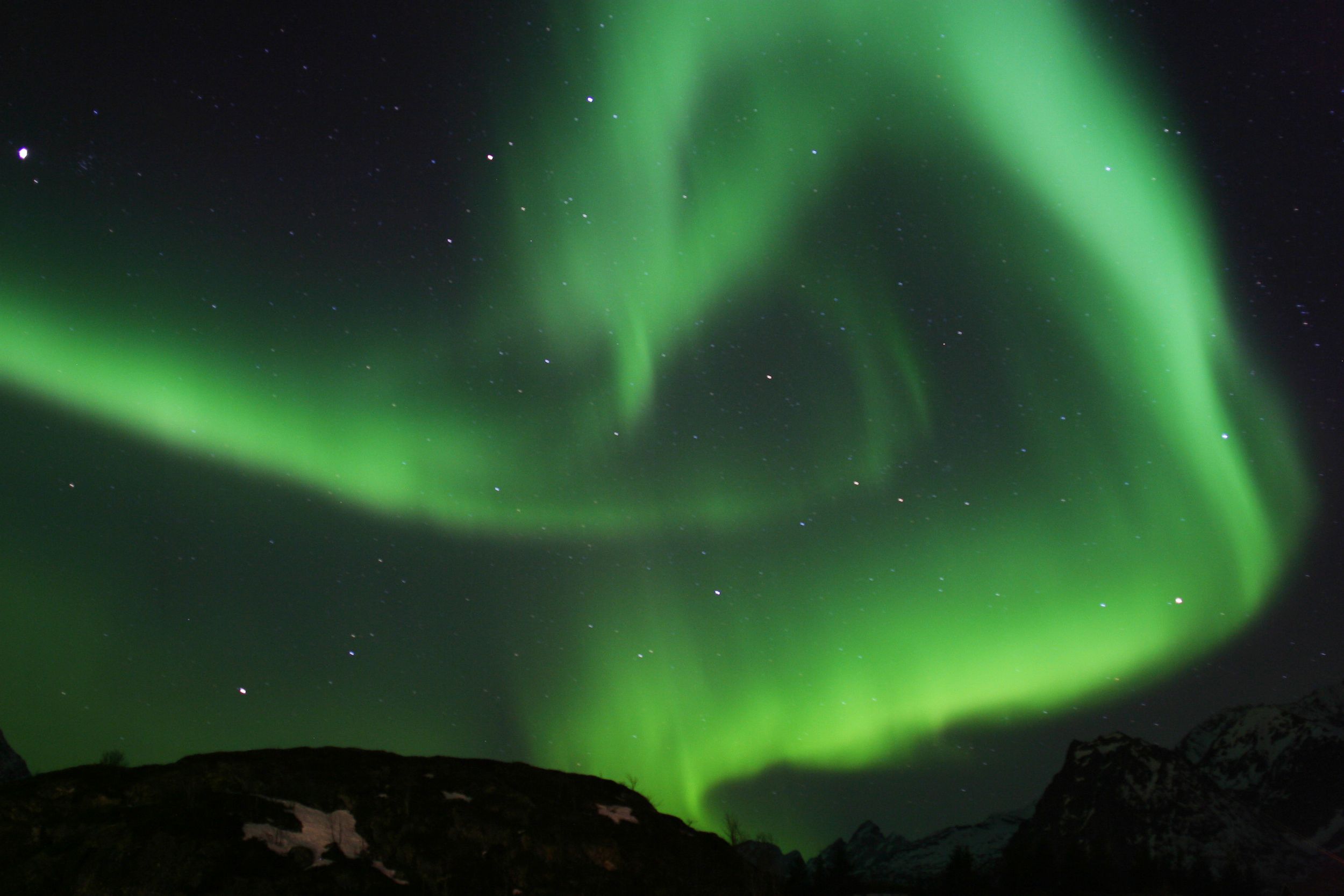
Kristian Birkeland and the Northern Lights: The Story of Haldde and Alta
Kristian Birkeland (1867–1917) was the Norwegian physicist who laid the foundation for how we explain the northern lights today: charged particles from the Sun, guided by Earth's magnetic field toward the polar regions. Much of his research took place in Alta, in Arctic Norway, where in 1899 he built an observatory on the mountain Haldde. It is regarded as the world's first permanent northern lights observatory.
Birkeland did not choose Alta by chance. By the time he arrived, scientists had been coming here to study the aurora for almost 60 years.
Why Alta became the cradle of aurora research
Alta sits directly beneath the auroral oval, the ring around the geomagnetic pole where the northern lights are most frequent. At the head of Altafjord, sheltered by mountains, the winter weather is also drier and calmer than on the outer coast. For a scientist, that means plenty of aurora and more clear nights to measure it.
Just as important was momentum. Each expedition left behind observations the next one could build on. According to Alta Museum, it was precisely those early measurements that sent Birkeland straight to Alta when he went looking for a mountain to work from.
1838: the French expedition that put Alta on the map
In August 1838 the French La Recherche expedition, backed by King Louis-Philippe, arrived to spend the winter in Alta. They had planned to base themselves in Hammerfest but chose Altafjord instead, because it had less cloud and fog. The scientists rented rooms at Madame Klerck's inn on the Bossekop farm and built three log cabins for their instruments.
Over the winter they calculated that the aurora hung between 90 and 150 kilometers (roughly 55–95 miles) above the ground, a remarkably good estimate for the time. The expedition artist, Louis Bevalet, painted the northern lights over Bossekop, and his images made this small Arctic trading post famous across Europe.
The Polar Year and the oldest surviving aurora photograph
During the first International Polar Year, 1882–83, Norway placed its main station at the Breverud farm in Bossekop, led by Aksel Steen. The Danish scientist Sophus Tromholt ran a station in Kautokeino, further inland. In his book Under Nordlysets Straaler ("Beneath the Rays of the Northern Lights," 1885), he wrote that few places could match Bossekop for observing the aurora.
On January 5, 1892, the German astronomer Martin Brendel, working with meteorologist Otto Baschin, pointed a camera at the sky over Bossekop and made a seven-second exposure. It is the oldest surviving photograph of the northern lights. Tromholt had attempted one in Christiania (today's Oslo) in 1885, but it was never published.
Birkeland's winter journey of 1897, by way of Gargia
Birkeland was a physics professor in Christiania, convinced that aurora research belonged on mountaintops, closer to the phenomenon itself. On February 2, 1897, he set off north with two assistants. On February 8 they reached Gargia, a mountain lodge on the edge of the Finnmark plateau. It is the same place Æventyr calls home today.
The journey nearly cost him his life. At Beskades, out on the plateau, Birkeland was caught in fierce wind and temperatures of around −25 °C (−13 °F). He came back that September and found the mountain he wanted: Haldde, roughly 900 meters (about 3,000 feet) above Kåfjord.
On a clear winter night at Gargia Lodge, it is hard not to think about him. The sky is the same one he watched, but our guests have warm clothes and a cozy lodge to come back to. Read more about why to stay at Gargia Lodge.
Life on Haldde, the first permanent aurora observatory
In 1899 Birkeland persuaded the Storting, Norway's parliament, to fund observatories on Haldde and on nearby Talviktoppen. He spent the winter of 1899–1900 on Haldde himself, through storms that tested both people and instruments.
In 1902–03 came the Norwegian Aurora Polaris Expedition, a network of Arctic stations centered on Kåfjord and Bossekop. Among the visitors to Haldde that winter was the polar explorer Roald Amundsen. Birkeland published the results in two large volumes in English, in 1908 and 1913, still considered a classic of space physics.
In 1910 Birkeland convinced the state to fund permanent operations, arguing that the observatory would also improve weather forecasts for fishermen in the north. From 1912 the physicist Ole Andreas Krogness ran the station and moved up with his family. Apartments were built for researchers, and at its busiest 17 people lived on the summit. Three children were born up there.
Gargia played a part here too. Between 1912 and 1915, researchers photographed the aurora from a network of stations around Alta, Gargia among them, with Haldde at the center.
Kristian Birkeland's northern lights theory, decades ahead of its time
Birkeland argued that the aurora is caused by charged particles from the Sun that Earth's magnetic field funnels toward the poles. To prove it, he built a terrella ("little Earth"): a magnetized sphere inside a vacuum chamber. When he fired electrons at it, glowing rings appeared around its poles, a miniature auroral oval.
He also proposed that electric currents flow along Earth's magnetic field lines between space and the upper atmosphere. Many scientists rejected the idea for decades, but satellite measurements in the 1960s and 1970s proved him right. Today they are called Birkeland currents. For the full modern explanation, see our guide to what causes the northern lights.
Birkeland was an inventor, too. With industrialist Sam Eyde he developed a way to pull nitrogen from the air to make fertilizer, which led to the founding of Norsk Hydro in 1905. His portrait and one of his drawings appeared on Norway's old 200-krone banknote. He died in Tokyo in 1917, aged 49.
Closure, fire and a second life
On August 31, 1926, the Storting voted to close Haldde. Research moved to Tromsø, where a new observatory opened in 1928, and that line continues in today's Tromsø Geophysical Observatory at UiT The Arctic University of Norway.
In the fall of 1944, retreating German occupation forces burned the observatory, as they burned most of Finnmark. Only the stone walls survived. Restoration began in the 1980s, and in 2018 the European Physical Society named Haldde a Historic Site.
Visiting the Haldde observatory today
Haldde (also spelled Halde) is now a popular hike. The marked trail follows the old cart road from the E6 highway just north of Kåfjord church, about 9 km (5.5 miles) to the observatory at 907 meters above sea level. Alta Museum puts it at around three hours up in summer at a normal pace, and the top 4 km follow the same road the scientists used more than a century ago.
- Parking: limited, near the trailhead in Kåfjord.
- Winter: parts of the route are exposed to avalanches. Check the Norwegian avalanche forecast at varsom.no, and only go with winter mountain experience and the right gear.
- Staying overnight: the oldest building, known as "Borgen" ("the Fortress"), is a self-service cabin of DNT, the Norwegian Trekking Association. You need a DNT key, and at least one person in your group must be a member. Current details are on ut.no.
- Respect the place: Haldde has long been regarded as a sacred mountain in Sámi tradition. Move quietly and leave the ruins as you find them.
Visiting Alta in winter and not up for a mountain? The Northern Lights Cathedral in town has an exhibition on Alta's aurora history.
Stand under Birkeland's sky
Alta became the cradle of aurora research for the same reasons it is a superb place to see the northern lights today: its position under the auroral oval, a drier climate and long, dark nights. Our complete guide to the northern lights in Alta has everything you need to plan a trip, and our northern lights page has the history timeline.
Want to see the sky that drew Birkeland north? Join one of our northern lights tours, starting from Gargia, where he stopped in 1897.
Your trusted guide to Arctic adventures. We specialize in creating unforgettable experiences in Alta, Norway.